My experience of ‘Workfare’

The subject of Workfare has, thanks to apparent blunder by someone at Tesco, been making headlines for the last few days.

There are, of course, a number of different of views on the matter, from the hysterical accusations of slavery made by rent seekers through to the more rational arguments provided by others.

Whilst I have been unemployed a few times in my life (immediately after university and a couple of times thanks to redundancy) I have never, as yet, had to sign-on (I looked into it post-uni but I had too much in savings – my debts not being taken into account).

During the first of those post-redundancy spells, in early 2002, work was, for an IT person with little commercial experience, proving difficult to come by.

At the time Dad was in charge of running down a small Indonesian firm based in London which had been used by either former President Suharto or his allies to launder money. Using the contacts he had through this he got me a position which allowed me to gain more commercial experience.

Whilst I was in this ‘role’ I was doing 35 hour weeks, 0900 to 1700, and commuting from my parents home to their office, which was 12 mins away by train.

What was my pay for this?

£20/week – with no expenses.

Did I complain? No. I wanted the experience and wasn’t worried about how I got it. It got me out of the house, stopped me feeling sorry for myself and once a month I was even able to go out for a few drinks with friends – aided by the fact that the weekly season ticket meant that I didn’t have to pay the train fare into town.

It also helped me get a job with a proper salary as, rather than a blank space on the CV, I could put down that I was working and could demonstrate the lengths I would go to help myself – something employers (especially at the SME end) quite like.

The Cost of Alcohol

Our glorious leader is all over the MSM this morning as they wibble on about what they have been told he will say on the subject of alcohol and ‘its cost to society’ when he visits a hospital today.

According to this pre-announcemet announcement, in 2006/7 (I assume they mean 2006/7 tax year), the cost was £2.7bn.

Sounds a lot, yes?

According to figures from the Office for National Statistics the government raised over £7.9bn through alcohol taxes in the 2006/7 tax year.

Now I realise that it has been almost 20 years since I sat down to do my dumbed down GCSE Maths exam but as far as I can see that is a net income to the Treasury of approximately £5.2bn.

Might I therefore suggest that iDave takes his latest piece of stupidity and sticks it?

Fairness and Mr. Fred Goodwin

So, Fred Goodwin is a Knight Bachelor no more as the award, originally made by the then Labour Government in 2004, has “cancelled and annulled” on the advice of the Honours Forfeiture Committee.

Predictably the mob is happy with this bone that they have been tossed by the Establishment. Also happy is our current Leader of the Opposition, even though in 2004 the silly fool was a Special Advisor in the Treasury…

Mr Goodwin is not though the first person to be subjected to this. Indeed Wikipedia lists several hundred people who have had titles and honours attainded in the last 1,000 years.

Those not of the mob have called this a political decision and unfair.

If one is to only take the period since the end of the first unpleasantness then, yes, they’d have a point. Aside from a few exceptions who should never have been given a gong in the first place (Mussolini, Ceauşescu, Mugabe) the reason for each annulment (when given) is a conviction.

However that was not always the case.

Attainder was, until recent times, something that only affected members of the nobility with each level of the British aristocracy, from the highest (Dukes) to the lowest (Barons) as well as the commoners (Baronets) having, at some point, had several members of their ranks suffer this fate. The said unfortunate was often then executed, although some did not live to suffer the ignominy – having had the good sense to die on the battlefield!

They were almost always attainded for political reasons. Or, more accurately, one political reason: finding themselves on the wrong side of the monarch (or, in the case of those lost as the result of squabbles over the succession, the now victorious monarch).

This practice, with two exceptions, however died out some centuries ago, with no peer of the realm suffering such a fate between the end of the Jacobite Rebellion and WW1 when two Dukes (both descendants of the House of Hanover) picked the wrong side.

So, no, the cancellation of Fred Goodwin’s knighthood might not have been fair, it might have been* political (and, as pointed out at Anna’s, there are other, perhaps more deserving, candidates) but it is not unprecedented and the British State can do a lot given that bit of leeway.

* was

A benefits sob story

As the Welfare Reform Bill returned to the Commons, the BBC decided to take up arms against the proposed benefit cap on behalf of one family (comprising two parents and six children) who would be affected if they were limited to £26,000/annum.

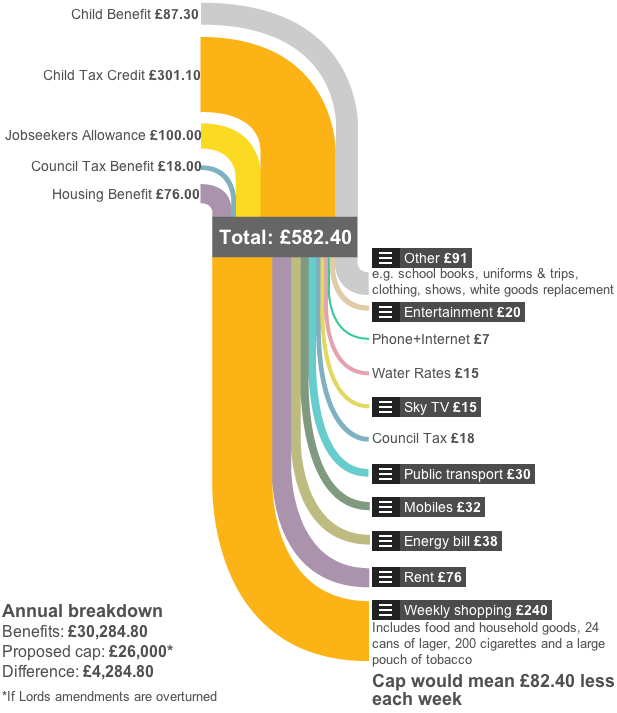
That family’s income is helpfully laid out in the graphic below:

How one family on benefits spends £582.40 a week (or £30,284.80 a year)

Looking at their outgoings the first thing that struck me was the amount being spent (per week remember) on alcohol, tobacco and Sky TV. Don’t get me wrong, I have nothing against smoking, drinking and watching TV but I am not in favour of (involuntarily) paying for others to do so.

Assuming that the family visit the ubiquitous Tesco for their shopping, that the prices online match those in store and they are buying in bulk then we can estimate the alcohol and tobacco expenditure as such:

Alcohol: Between £18 and £24
Cigarettes: Between £60 and £70
Tobacco: £12+

You can probably do better if you shop around a bit but even at the lower end the estimate for alcohol and tobacco expenditure is £90+, rising to over £100 depending on personal preferences.

Add in £15 for Sky TV and that’s at least £105, which is well above the £82.40 the BBC reckons they would lose under the benefit cap.

The second thing that struck me about this sob story was the what the father does (or rather doesn’t) do for a living:

Raymond, a former educational software writer, has been jobless since 2001. His wife Katherine suffers from bipolar disorder with an anxiety disorder and is also unable to work.

Says Ray: “The market for my skills dried up ten years ago – there’s a total lack of work in my area of expertise.”

Seriously? Your skill-set has been obsolete for 10 years and you never even thought at retraining yourself into another area? Even with the dot com crash, it isn’t as if there has been a shortage of IT jobs (I assume that an ‘educational software writer’ has some programming skills) in the last decade.

And as if that wasn’t enough, my eyebrows almost shot through the ceiling when I realised that dear old unemployed Raymond and his disabled wife, already having six children between them from previous marriages, also have a 5 year old son as a result of their union.

No cutting your coat according to your cloth for these two. Oh no, the poor bloody taxpayer all the way it seems…

The father reckons that, as a result of the cap, I see eight people here having to choose between eating or heating.

I reckon he needs to pull the other leg, the one with bells on it…

Smacking

David Lammy, the MP for Tottenham, has aroused the ire of many by suggesting that one of the reasons behind last summer’s riots is that parents are afraid to smack their children.

In an interview with LBC Radio to publicise his book (Out Of The Ashes: After The Riots) Lammy said:

“Many of my constituents came up to me after the riots and blamed the Labour Government, saying: ‘You guys stopped us being able to smack our children’.

“I have to say when this was first raised with me I was pretty disparaging. But I started to listen. These parents are scared to smack their children and paranoid that social workers will get involved and take their children away.”

Whilst smacking has not yet be outlawed in the UK, the smacker must not leave a mark (including reddening of the skin) on the body of the child and the decision on whether or not the smacking is reasonable can be up to a social worker if someone complains.

Putting my amusement of Mr Lammy squirming as his constituents attacked legislation passed by a governing party of which he was a member to one side, as a Libertarian the use of smacking is an issue where I find myself slightly confused.

At first glance, it certainly seems to violate the ‘harm’ principle as when you are dealing with children the action cannot be consensual*. However as parent you are responsible for looking after your children and doing what is best for them.

As no decent parent particularly wishes to harm their children, smacking is not a first response to misbehaviour but the last one. If you are dealing with a repeat offence and other approaches have already been tried, a few smacks on the bottom to associate – in the mind of the child – certain unwanted behaviour with pain has to be an option.

If the end result is a better behaved child then is it a entirely bad thing?

Given my personal dislike of children it is unlikely that I will ever be put in the position to have to smack any of my own but if I was then I think I would, but only as the option of last resort.

It is probable though that my views on the matter are clouded by my own childhood experiences. Both my brother and I found ourselves turned over dad’s knee occasionally whilst we were growing up and, with the benefit of hindsight, we probably deserved it each and every time. Yes, it bloody well hurt (dad used either his hand or the slipper) but I doubt we found ourselves in that position more than once every 6 months and only then because we had well and truly crossed an already defined line.

Did it do either of us any harm? Well we both got to 18 without getting into trouble with the police so in the long run I’d say that somehow my parents managed to do an ok job.

* Adults are, of course, a different matter but that is entirely between you and your partner(s) 😉

“And that sweet city with her dreaming spires…”

I’m sure by now many of us have at least heard of one Elly Nowell, the A-Level student who sent a ‘rejection’ letter to Magdalen College, Oxford.

If you haven’t yet read the letter, I have reproduced it in full here:

Dear University,

I have now considered your establishment as a place to read Law (Jurisprudence). I very much regret to inform you that I will be withdrawing my application. I realise you may be disappointed by this decision but you were in competition with many fantastic universities and following your interview I am afraid you do not quite meet the standard of the universities I will be considering.

I encourage you to try again for my LLM but re-applicants are at a disadvantage and you are unlikely to succeed unless you become a more progressive university. See below for guidelines for re-application.

I hope you will be successful in finding other capable candidates and I wish you every success in your future as a university.

Thank you for your interest in me

Your sincerely
Elly Nowell

Guidelines for Re-application

1) Whilst you may believe your decision to hold interviews in grand formal settings is inspiring, it allows public school applicants to flourish in the environment they are accustomed to and intimidates state school applicants, distorting the true academic potential of both.

2) Whilst you may believe your traditions and rituals are impressive, they reflect badly on your university. As an institution that preaches academic excellence, teaching your students to blindly and illogically do whatever they are told reveals significant flaws in your education system. Frankly. I feel humiliated for both you and your students.

3) During my time at Magdalen College the obvious gap between minorities and white middle-class students was embarrassing. Whilst I realise you are trying to address these problems within your university, the gap between elitism and discrimination is a narrow one and one that you still do not appear to have adequately addressed.

4) Perhaps offer a glass of water in your interviews next time: it is rude to torture guests.

The first part is slightly amusing, if somewhat unusual approach, to rejecting a college to which you have applied to attend. I imagine that most would be students don’t even bother with a letter (I know I didn’t).

It is her ‘guidelines’ however where I feel she has shown herself up.

‘Grand formal settings’? We are talking about a college that has been around for 550 years, a college which is part of the oldest university in the English speaking world, in a city that received its chart in 1191, and boasts buildings built in times before concrete, glass and steel constructs become the norm. Described by Matthew Arnold as the ‘City of dreaming spires’, immortalised on television thanks to ‘Morse’ and ‘Lewis’ one has to ask what on earth she expected? Frankly, if she had wanted a 1960s monstrosity then she should have applied to the University of Essex.

With age cometh traditions and rituals and after 550 years I’d be shocked if Magdalen didn’t have any. As with all traditions though no doubt some will be good and some will be bad but when the college is one of the best at Oxford (according to the JCRs website) it doesn’t seem as though there are that many ‘flaws’ in their education system.

Bitching about skin colour and class? Why? If someone is good enough to be there then who cares what their background is or what colour they are.

Finally, might I suggest that if someone has forgotten to offer you a glass of water/tea/coffee, you might in future ask? It’ll be an odd place that says no!

Sadly through young Elly is not finished. On Thursday she was invited to write a piece for Comment is Free in order to explain why she sent her letter.

Most of the piece though is fluff with the meat coming towards the end.

So, why did I apply in the first place? If you’re achieving high grades at A-level (or equivalent) you can feel quite a lot of pressure to “prove yourself” by getting an Oxbridge offer. Coupled with the fact that I grew up on benefits in council estates throughout Bristol – not a type of heritage often associated with Oxbridge interview – I decided to give it a try.

Colleges, even Brockenhurst where Elly went (which is one of the best in the country), like the idea of sending some of their students to Oxford or Cambridge. It is a pat on the back for them as well so they will encourage their brightest to make an application. Perhaps it is not always the best choice but it doesn’t preclude prospective undergraduates from applying elsewhere.

It was only at interview that I started to question what exactly I was trying to prove. I was well aware that fantastic candidates are often turned down, and I did not believe that this was a true reflection of their academic potential. It no longer made any sense to me to subject myself to their judgment, and so I withdrew my application.

So you felt, after ‘giving it a try’, that it wasn’t for you. Big deal. You are hardly the first and I somewhat doubt you will be the last. I don’t recall anyone else writing a letter about it and getting themselves a column in CiF though.

As to my opinions on the future of Oxbridge, I share many of the views put forward by Owen Jones . Although I take issue with his concern that not going to Oxbridge gives you a “chip on your shoulder”, which seemingly makes your opinion less valid. I did not write to Oxford to avoid the risk of being labelled as an “Oxbridge reject”: I already am one. Last year I made an (admittedly weak) application to Cambridge and was inevitably rejected post-interview. I am proud of the so-called “chip on my shoulder” and I do not believe anyone’s opinion should be invalidated simply because they did not attend Oxbridge.

Sharing the views of Owen Jones? A 20 something, self-confessed fourth generation socialist who himself went to Oxford and whose media resume is so full of ‘right-on’ organisations I can’t read it without laughing?

I fully suspect that at some point after graduation Ms Nowell will, instead of sinking into obscurity, be working in the Westminster Village and shall eventually become a Labour MP, complete with that chip on her shoulder. I, for one, am not looking forward to that day.

A quick thought on council house abuse

Housing Minister Grant Shapps has this morning announced that the government is considering criminalising subletting of council homes with the punishment potentially being up to 2 years in prison and fines of up to £50,000.

Given that those who are abusing the system are simply taking advantage of the fact that council rents are subsidised, why not just remove the subsidy and hence the distortion it makes in the market?

Or is that too simple?

Meat, glorious meat…

Given that it is the Christmas silly season, stupidity from those who think that they are our betters is only to be expected. Thus, on the heels of David Cameron saying he wants minimum pricing for alcohol, we have Professor Tim Lang of City University, an advisor to Department for the Elimination/Eradication of Farming and Rural Affairs under the last government and now on the Mayor of London’s Food Board, telling us that we eat too much meat.

*pauses for a bacon sandwich*

According to the good prof, we should go back to those times when meat was only consumed on high days and holidays. If we did this we would supposedly be healthier (less obesity, heart disease and type 2 diabetes) and help Gaia all at the same time.

*pauses for a medium rare fillet steak*

It would appear that Tim needs to study his history a bit more because, whilst he is correct to say that meat consumption was lower, he doesn’t appear to understand why this was.

Put simply, they were poorer. In the middle ages (and I accept I am generalising here) the serfs working the fields for their feudal landlord only ate meat at certain times because they couldn’t afford to have it every day. The wealthy (the nobility and the clergy) though could and thus did eat meat pretty much on daily basis.

Thankfully for all of us things have changed for the better since then. The majority of us are no longer breaking our backs working the land in the hope of growing enough that, once tithes are taken into account, we can afford to feed ourselves and our families. The revolutions in agriculture and industry from the 18th century onwards meant that more food was produced for less effort and thus real term costs fell.

I would suggest to Tim that, in future, he consults his university’s history department but looking at their website it appears that City University does not have one…

Or is he, as seems common with the Green agenda, suggesting that we throw out almost three hundred years of progress and go back being subsistence farmers? Only this time, no doubt, it will be with him and his fellow travellers as the feudal landlords…

I’m hungry. Who’s for some pork scratchings?

It is only someone else’s money…

As we know tomorrow sees a nationwide strike by many members of the public sector. As a consequence of this those that do strike will lose their wages for the day, leaving their employers – us – with a small windfall of cash.

What then to do with it?

Oh come on, you didn’t really think we were going to get a refund, did you?

Instead those who steal the money from us will spend it themselves and we can only hope it gets plough back into ‘services’. I won’t hold my breath though.

Still, at least I’m not living in Newcastle. The council there has, in an astounding lack of concern for those who pay their way, decided to give the money away to local charities:

Newcastle Council has pledged to hand over the wages it saves as a result of Wednesday’s national strike – potentially up to £100,000 – to good causes.

Typically this throwing away of other people’s money finds favour amongst rent seekers and unions.

Brendan Barber, TUC:

Other public services employers up and down the country should now consider following their example and direct savings from next week’s strike to help those hit hardest by the government’s policies.

Clare Williams, Northern Public Services Alliance:

It is a sign of trade union members’ ongoing commitment to helping the most vulnerable that they’ve led the way with this groundbreaking initiative in Newcastle.

Jo Curry, VONNE:

We encourage other public service employers in other areas across the region to follow Newcastle’s lead.

*speechless*

On the difficulty of buying booze

Hello, my name is MG. I’m 33 years old and I need to tell you that sometimes I like to buy alcohol from my local Tesco supermarket.

In a country populated by grown-ups that had a government with a relaxed attitude to the drinking habits of the citizenry such a confession would obviously be unnecessary.

However as we all know the UK has none of these things which is why I find myself confronted, with increasing regularity, with demands from the checkout assistants that I produce ID to confirm that I am indeed old enough to purchase the wine or beer that sometimes falls into my shopping basket.

You would have thought that it should be fairly easy to realise that I am clearly an adult, even if you are unable to say exactly how far beyond the currently minimum legal age of 18 I am. Sadly this is not the case as my local store operates a policy of asking for ID if you don’t look over 25.

Yes, the first time I was asked I was flattered. However as I do not habitually carry ID with me – UK law not yet requiring me to do so – this quickly turned into irritation and these days I save time by just going straight to irritated.

On the first few times I argued but you quickly learn that arguing with a checkout assistant is like arguing with a brick wall (and their supervisors are no better) so I no longer bother and instead start unpacking any goods I have already placed into my bags back to the checkout before picking up my (now empty) bags and walking out of the store.

This inane idea of challenging anyone who might be under 25 is the follow up to the ‘Challenge 21’ policy and is the brainchild of the Retail of Alcohol Standards Group (RASG) and it is co-ordinated by the Wine and Spirit Trade Association (WSTA).

It’s purpose? To reduce the amount of alcohol sold to under 18s. It’s members? Most, if not every, supermarket chain operating in the UK.

Why does it exist? Because following a meeting with Charles Clarke, one of the many authoritarian Home Secretaries this country had to put up with under the last government, the retailers apparently mutually agreed to sell out and get into bed with government, rather than to stand up to them and live with the bullying that would have probably otherwise have followed. Thus ‘Challenge 21’ was born.

However as those blessed with half a brain cell and an understanding of history know, surrendering just means you get to spend a good long while being someone else’s bitch. In the case of the RASG this means that their work is supported by the Home Office, the Department of Culture, Media and Sport and the Department of Health.

This is apparently evidenced by the newer ‘Challenge 25‘ scheme:

However, with levels of sales to minors still not low enough and the personal consequences of illegal sales for the member of shop staff more severe, retailer employees requested a program which gives them a greater backing and a higher margin of error in challenging customers for proof of age.

Yes, when it is your paycheque on the line, you want to do your damnedest to ensure that you don’t get screwed over. Sadly it also means that common sense tends to go out of the window at the same time.

However how much did the RASG fight when the government of the day looked to start imposed these harsher penalties – or did their previous lack of doing so mean that they had no corner to fight?

I think it is probably safe to say that it was the government which decided that the level of alcohol sales to minors was still too high, although what that figure is I do not know – but one suspects that any figure above zero would be considered too high. Given that the utter elimination of alcohol sales to children is impossible, will the industry wake up to the situation they have found themselves in or are they now, like CAMRA, completely suffering from Stockholm Syndrome?

I meanwhile have decided that the time has come to find another supermarket to spend my money in.