
That budget then

So, George Osborne has delivered this year’s budget – or, more accurately, confirmed the press leaks of the last few days. Quite frankly one wonders why he bothered standing up.

I think it is safe to skip rapidly over the growth forecasts provided by the OBR as the record of their gypsy fortune-tellers predictions is poor to say the least.

Equally, the less said about his wish for a balanced economy the better. Wishing for it is fine but I’d be happy if the government kept its paws out of the matter* as much as possible and left it up to the free market to sort out.

Borrowing

As he stated back in the Autumn, the government will continue to live beyond what it steals from the taxpayer past the end of this parliament (assuming it goes the distance). Indeed it doesn’t forecast a ‘balanced’ budget before 2017/18. In the mean time the National Debt is forecast to increase by £126bn (2012/13), £120bn, £98bn, £75bn, £52bn and £21bn (2016/17). That is a whopping £492bn – and all of which may, one day, have to be paid back.

I say one day because as we know the traditional way for government to deal with debt is to inflate it away and in 100 years time it is more than likely that that £492bn will be a lot closer to chump change than it is now. Gideon’s wheeze for delaying the inevitable for as long as possible is 100-year or perhaps even perpetual (i.e. non-repayable) gilts.**

Public Sector

Sadly there was no announcement of an immediate end of national pay bargaining. The Chancellor did though appear to thank the opposition for suggesting the end of national benefit rates – perhaps the only useful idea to emerge from Labour in a while. It would also make sense to make the NMW regionalised (assuming it is politically impossible at present to scrap it entirely).

Taxes

Let’s face it, the only thing anyone really cares about is how much the government is planning on stealing from them in direct taxation each year. The stupidity of it is how pathetically grateful we all get when we learn that it might not be as much as last year… without realising that they generally claw it back through indirect taxation instead.

The apparent good news for anyone earning less than £100k is that the government has decided it won’t start its thieving in the forthcoming tax year until you’ve earnt £8,105 – and next year is pushing that level up £9,205.

Obviously this is a good thing for anyone earning minimum wage sort of levels. Personally I think it would be better if no-one doing a 40hr week at NMW (which currently works out to £12,646.40) paid any tax but things seem to be moving in the right direction. The test will be what happens once the £10k level, as agreed at the start of the collation, is reached.

The likely option is that government of the day will starting treating it just like they do the the other tax thresholds and allow it to increase slower than wages, thus once again catching more people in the net.

What the Chancellor didn’t mention whilst he was crowing about the changes to the 0% band was that the £630 increase there is mirrored by pulling the 40% threshold down by £630, shrinking the 20% band by £1,260. This ensures that – for those under 65 – that the the 40% band still starts at anything over £42,475. This is the same tactic that the one-eyed Scottish idiot employed on a few occasions.

Together with the lack of change of the levels at which the tax free allowance is withdrawn and the highest rate of Income Tax is levied, the government is once again ensuring that, as wages rise, more people are dragged into the higher tax brackets.

Unlikely those of us who are earning to try to keep ourselves in drinking money, those who have reached pensionable age will find their 0% band frozen from 2013. If I am to guess, this is in order to equalise them with the rates for the under 65s in preparation for the merger of Income Tax and National Insurance – something which will also hit pensioners as they do not currently pay NI.

The positive sides of merging IT and NI should be
a) simplification of the tax code, and
b) give the population a better idea of what the basic rate of tax (excluding Employer’s NI) is.

With any luck, being told that the basic rate is actually over 30% (rather than the 20% they believe) may result in the sheeple demanding that it comes down…

For those on very high incomes, the semi-good news is that the highest rate of income tax is coming down. Not yet scrapped altogether (hopefully in a future budget) but being halved. Given the flagrant avoidance that took place before the 50% rate come into effect – and which will be duplicated now as people who can hold off until 2013 – this can only be a good thing. Will 45p in the pound (and the potential direction of travel) tempt those who haven’t yet upped sticks to stay though?

Excellent news for companies employees, shareholders and customers is that corporate tax is coming down even further with the aim of getting it to 22% from 2014. Not quite Ireland but better than France and Germany which may encourage those financial institutions who were thinking of leaving before a Tobin tax in introduced in those places. The increase in the bank levy may however put them off.

The so-called sin taxes generally slipped by without change to already announced increases except for the price a tobacco***. I imagine that the only people who were cheering this rise of inflation plus 5% (plus consultation on making tobacco-free cigarettes liable to excise duty) were the smugglers. As a non-smoker I would be open to the idea of bringing back duty-free smokes for people when re-entering the country…

Regulation

As trailed, Sunday trading laws are to be relaxed during the Olympics. Hopefully they will then be scrapped altogether as an anachronism.

Planning – perhaps the major reason for the cost of housing being so high – is being simplified. Supposedly the guidance is being cut to just 5% of its previous size although there is no word of whether part of this has been achieved by the use of single instead of double line spacing and a reduced font size.

We are also getting more ‘enterprise zones’. Why not just make the entire country one?

And Michael ‘Tarzan’ Heseltine is back. Has anyone checked him for knives?

Infrastructure

It would seem that the Government has finally realised that we do need more (or bigger) airports. Will Heathrow be getting that third runway after all? We might find out come the summer.

Annoyingly (but not surprisingly) the Government will continue to waste money on ‘green’ energy but in better news looks to be reversing the hit it gave the North Sea oil and gas industry last year.

Conclusion

One thing that this is not is a Libertarian budget. Government spending is still going up and Peter, let alone Paul, is being robbed to pay Peter.

To the laywoman (i.e. me) it appears to be yet another budget that just tinkers with things whilst fleecing the public for more money – a speciality which Gordon Brown perfected. There is however some future potential in it if some things (the IT and NI merger, national pay bargaining) do happen. To mis-quote that school report line no-one ever wanted to see: “could do a damn sight better”.

* Yeah, I know. Government leaving alone is wishful thinking, huh? Let’s just be thankful he isn’t attempting to plan the economy.

** It is ideas like this which make me glad that I’m never going to have children.

*** Ok, gambling as well as tax will be imposed at point of consumption in an effort to stop online gambling moving offshore.
Clinging to the Wreckage

Eric Joyce, former Army Major, thug and the most expensive MP in the country – by allowances – has resigned from the Labour Party following his assault conviction saying:

“…the standard of my conduct fell egregiously below what is required by a member of this House, or indeed anyone, anywhere”.

Which is all well and good as far as it went but sadly he somehow forgot to say that he was taking up the Stewardship of the Manor of Northstead.

This ‘egregious’ oversight means that we are apparently stuck with him and his expense account until the 2015 General Election (assuming this Parliamentary term goes the distance) at which he has said he will not stand.

Whatever happened, I wonder, to that promised ‘right of recall’..?

Those French Elections

I haven’t, I confess, been taking much interest in the reshuffling of the presidential deck chair that is the forthcoming French General Election but it seems as if Sarkozy is currently expected to finish no higher than the first loser’s spot.

And it looks like Sarkozy is worried as well, if his threat to quit politics if he loses is to be taken with anything more than a pinch of salt.

After his election rally on Sunday however when he lurched sharply towards a position of anti-immigration and economic protectionism I think I can put a handle on his election campaign:

  1. Avoid doing a Lionel Jospin in the first round.
  2. Court those who are likely to vote for the French National candidate, Marine Le Pen in the first round in the hope they will win him the second round.

How depressingly negative.

My experience of ‘Workfare’

The subject of Workfare has, thanks to apparent blunder by someone at Tesco, been making headlines for the last few days.

There are, of course, a number of different of views on the matter, from the hysterical accusations of slavery made by rent seekers through to the more rational arguments provided by others.

Whilst I have been unemployed a few times in my life (immediately after university and a couple of times thanks to redundancy) I have never, as yet, had to sign-on (I looked into it post-uni but I had too much in savings – my debts not being taken into account).

During the first of those post-redundancy spells, in early 2002, work was, for an IT person with little commercial experience, proving difficult to come by.

At the time Dad was in charge of running down a small Indonesian firm based in London which had been used by either former President Suharto or his allies to launder money. Using the contacts he had through this he got me a position which allowed me to gain more commercial experience.

Whilst I was in this ‘role’ I was doing 35 hour weeks, 0900 to 1700, and commuting from my parents home to their office, which was 12 mins away by train.

What was my pay for this?

£20/week – with no expenses.

Did I complain? No. I wanted the experience and wasn’t worried about how I got it. It got me out of the house, stopped me feeling sorry for myself and once a month I was even able to go out for a few drinks with friends – aided by the fact that the weekly season ticket meant that I didn’t have to pay the train fare into town.

It also helped me get a job with a proper salary as, rather than a blank space on the CV, I could put down that I was working and could demonstrate the lengths I would go to help myself – something employers (especially at the SME end) quite like.

The Cost of Alcohol

Our glorious leader is all over the MSM this morning as they wibble on about what they have been told he will say on the subject of alcohol and ‘its cost to society’ when he visits a hospital today.

According to this pre-announcemet announcement, in 2006/7 (I assume they mean 2006/7 tax year), the cost was £2.7bn.

Sounds a lot, yes?

According to figures from the Office for National Statistics the government raised over £7.9bn through alcohol taxes in the 2006/7 tax year.

Now I realise that it has been almost 20 years since I sat down to do my dumbed down GCSE Maths exam but as far as I can see that is a net income to the Treasury of approximately £5.2bn.

Might I therefore suggest that iDave takes his latest piece of stupidity and sticks it?

Fairness and Mr. Fred Goodwin

So, Fred Goodwin is a Knight Bachelor no more as the award, originally made by the then Labour Government in 2004, has “cancelled and annulled” on the advice of the Honours Forfeiture Committee.

Predictably the mob is happy with this bone that they have been tossed by the Establishment. Also happy is our current Leader of the Opposition, even though in 2004 the silly fool was a Special Advisor in the Treasury…

Mr Goodwin is not though the first person to be subjected to this. Indeed Wikipedia lists several hundred people who have had titles and honours attainded in the last 1,000 years.

Those not of the mob have called this a political decision and unfair.

If one is to only take the period since the end of the first unpleasantness then, yes, they’d have a point. Aside from a few exceptions who should never have been given a gong in the first place (Mussolini, Ceauşescu, Mugabe) the reason for each annulment (when given) is a conviction.

However that was not always the case.

Attainder was, until recent times, something that only affected members of the nobility with each level of the British aristocracy, from the highest (Dukes) to the lowest (Barons) as well as the commoners (Baronets) having, at some point, had several members of their ranks suffer this fate. The said unfortunate was often then executed, although some did not live to suffer the ignominy – having had the good sense to die on the battlefield!

They were almost always attainded for political reasons. Or, more accurately, one political reason: finding themselves on the wrong side of the monarch (or, in the case of those lost as the result of squabbles over the succession, the now victorious monarch).

This practice, with two exceptions, however died out some centuries ago, with no peer of the realm suffering such a fate between the end of the Jacobite Rebellion and WW1 when two Dukes (both descendants of the House of Hanover) picked the wrong side.

So, no, the cancellation of Fred Goodwin’s knighthood might not have been fair, it might have been* political (and, as pointed out at Anna’s, there are other, perhaps more deserving, candidates) but it is not unprecedented and the British State can do a lot given that bit of leeway.

* was

A benefits sob story

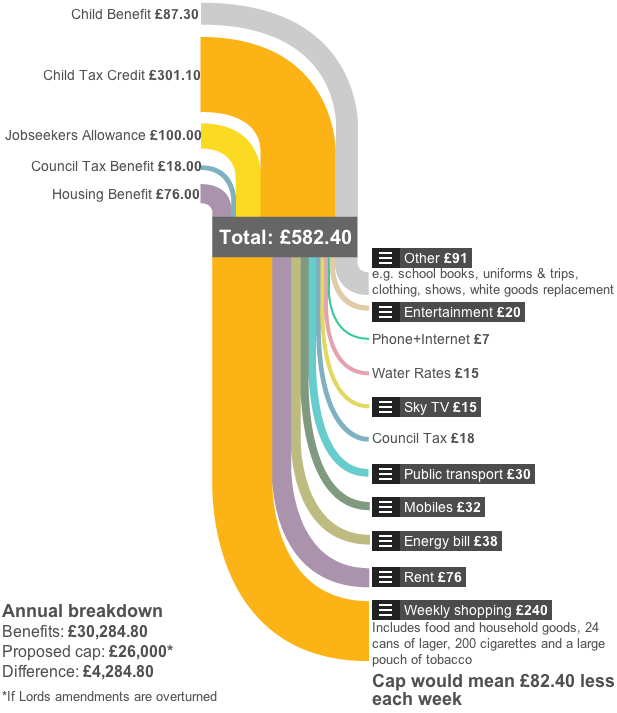
As the Welfare Reform Bill returned to the Commons, the BBC decided to take up arms against the proposed benefit cap on behalf of one family (comprising two parents and six children) who would be affected if they were limited to £26,000/annum.

That family’s income is helpfully laid out in the graphic below:

How one family on benefits spends £582.40 a week (or £30,284.80 a year)

Looking at their outgoings the first thing that struck me was the amount being spent (per week remember) on alcohol, tobacco and Sky TV. Don’t get me wrong, I have nothing against smoking, drinking and watching TV but I am not in favour of (involuntarily) paying for others to do so.

Assuming that the family visit the ubiquitous Tesco for their shopping, that the prices online match those in store and they are buying in bulk then we can estimate the alcohol and tobacco expenditure as such:

Alcohol: Between £18 and £24
Cigarettes: Between £60 and £70
Tobacco: £12+

You can probably do better if you shop around a bit but even at the lower end the estimate for alcohol and tobacco expenditure is £90+, rising to over £100 depending on personal preferences.

Add in £15 for Sky TV and that’s at least £105, which is well above the £82.40 the BBC reckons they would lose under the benefit cap.

The second thing that struck me about this sob story was the what the father does (or rather doesn’t) do for a living:

Raymond, a former educational software writer, has been jobless since 2001. His wife Katherine suffers from bipolar disorder with an anxiety disorder and is also unable to work.

Says Ray: “The market for my skills dried up ten years ago – there’s a total lack of work in my area of expertise.”

Seriously? Your skill-set has been obsolete for 10 years and you never even thought at retraining yourself into another area? Even with the dot com crash, it isn’t as if there has been a shortage of IT jobs (I assume that an ‘educational software writer’ has some programming skills) in the last decade.

And as if that wasn’t enough, my eyebrows almost shot through the ceiling when I realised that dear old unemployed Raymond and his disabled wife, already having six children between them from previous marriages, also have a 5 year old son as a result of their union.

No cutting your coat according to your cloth for these two. Oh no, the poor bloody taxpayer all the way it seems…

The father reckons that, as a result of the cap, I see eight people here having to choose between eating or heating.

I reckon he needs to pull the other leg, the one with bells on it…

Smacking

David Lammy, the MP for Tottenham, has aroused the ire of many by suggesting that one of the reasons behind last summer’s riots is that parents are afraid to smack their children.

In an interview with LBC Radio to publicise his book (Out Of The Ashes: After The Riots) Lammy said:

“Many of my constituents came up to me after the riots and blamed the Labour Government, saying: ‘You guys stopped us being able to smack our children’.

“I have to say when this was first raised with me I was pretty disparaging. But I started to listen. These parents are scared to smack their children and paranoid that social workers will get involved and take their children away.”

Whilst smacking has not yet be outlawed in the UK, the smacker must not leave a mark (including reddening of the skin) on the body of the child and the decision on whether or not the smacking is reasonable can be up to a social worker if someone complains.

Putting my amusement of Mr Lammy squirming as his constituents attacked legislation passed by a governing party of which he was a member to one side, as a Libertarian the use of smacking is an issue where I find myself slightly confused.

At first glance, it certainly seems to violate the ‘harm’ principle as when you are dealing with children the action cannot be consensual*. However as parent you are responsible for looking after your children and doing what is best for them.

As no decent parent particularly wishes to harm their children, smacking is not a first response to misbehaviour but the last one. If you are dealing with a repeat offence and other approaches have already been tried, a few smacks on the bottom to associate – in the mind of the child – certain unwanted behaviour with pain has to be an option.

If the end result is a better behaved child then is it a entirely bad thing?

Given my personal dislike of children it is unlikely that I will ever be put in the position to have to smack any of my own but if I was then I think I would, but only as the option of last resort.

It is probable though that my views on the matter are clouded by my own childhood experiences. Both my brother and I found ourselves turned over dad’s knee occasionally whilst we were growing up and, with the benefit of hindsight, we probably deserved it each and every time. Yes, it bloody well hurt (dad used either his hand or the slipper) but I doubt we found ourselves in that position more than once every 6 months and only then because we had well and truly crossed an already defined line.

Did it do either of us any harm? Well we both got to 18 without getting into trouble with the police so in the long run I’d say that somehow my parents managed to do an ok job.

* Adults are, of course, a different matter but that is entirely between you and your partner(s) 😉

A quick thought on council house abuse

Housing Minister Grant Shapps has this morning announced that the government is considering criminalising subletting of council homes with the punishment potentially being up to 2 years in prison and fines of up to £50,000.

Given that those who are abusing the system are simply taking advantage of the fact that council rents are subsidised, why not just remove the subsidy and hence the distortion it makes in the market?

Or is that too simple?

It is only someone else’s money…

As we know tomorrow sees a nationwide strike by many members of the public sector. As a consequence of this those that do strike will lose their wages for the day, leaving their employers – us – with a small windfall of cash.

What then to do with it?

Oh come on, you didn’t really think we were going to get a refund, did you?

Instead those who steal the money from us will spend it themselves and we can only hope it gets plough back into ‘services’. I won’t hold my breath though.

Still, at least I’m not living in Newcastle. The council there has, in an astounding lack of concern for those who pay their way, decided to give the money away to local charities:

Newcastle Council has pledged to hand over the wages it saves as a result of Wednesday’s national strike – potentially up to £100,000 – to good causes.

Typically this throwing away of other people’s money finds favour amongst rent seekers and unions.

Brendan Barber, TUC:

Other public services employers up and down the country should now consider following their example and direct savings from next week’s strike to help those hit hardest by the government’s policies.

Clare Williams, Northern Public Services Alliance:

It is a sign of trade union members’ ongoing commitment to helping the most vulnerable that they’ve led the way with this groundbreaking initiative in Newcastle.

Jo Curry, VONNE:

We encourage other public service employers in other areas across the region to follow Newcastle’s lead.

*speechless*